{ require_once('class.compressor.php'); //Include the class. The full path may be required } $compressor = new compressor('css,javascript,page'); Left In Aboite <$BlogMetaData>


Monday, February 11, 2008

Sauron's Kingdom - Air Pollution in Moscow

The above photo, taken by Alexander Petrenko, is of the city of Moscow:

Over the past two years escalating numbers of vehicles on the roads put a stifling strain on the environment. Today Moscow has nearly 3,000,000 cars. Gray-brown noxious haze of smog covers the streets filled with jam-packed traffic, which blows out tons of unhealthy exhaust fumes of carbon monoxide and other harmful chemicals. Additionally there are 12 huge heat power stations, 53 district heating stations and 3,000 industrial enterprises still operating within the city borders. As a result concentrations of harmful substances often exceed maximum allowable by 10-20 times.

The level of air pollution varies from one neighborhood of the city to another. This accounts for the variability of child health levels. In the most severely polluted areas the prevalence of childhood bronchial asthma is much higher, and the cases of disharmonious physical development among children are more frequent.


I'll never complain about driving through Gary, Indiana again. Ever. Just remember though, it is egotistical of us to believe that mankind can affect our environment. I know it's true, all of the conservatives keep repeating it en masse. . .

Labels: , , , ,

AddThis Social Bookmark Button

Sunday, August 19, 2007

Stripping for the Environment

Nearly 600 volunteers have stripped for the camera on a melting Swiss glacier high in the Alps for a publicity campaign to expose the impact of climate change.

Greenpeace, which commissioned the photo shoot by world-renowned photographer Spencer Tunick, says the volunteers turned up under blue skies near the foot of the Aletsch glacier, a protected UNESCO World Heritage site.

Nicolas de Roten of Greenpeace Switzerland counted almost 600 people in attendance. "It's relatively chilly but that doesn't seem to be disturbing them," he said.

Greenpeace says the human body is as vulnerable as glaciers like the Aletsch in southern Switzerland - which is shrinking by more than 100 metres a year - and the world's environment.

Shrinking was probably an unfortunate term to use in this story. . .

Labels:

AddThis Social Bookmark Button

Monday, July 09, 2007

FOX attacks. . .the environment.

Labels: ,

AddThis Social Bookmark Button

Thursday, June 14, 2007

The "end times" for "peak oil"

Scientists led by the London-based Oil Depletion Analysis Center, report that global production of oil is set to peak in the next four years before entering a steepening decline which will have massive consequences for the world economy and the way that we live our lives.

According to “peak oil” theory our consumption of oil will catch, then outstrip our discovery of new reserves and we will begin to deplete known reserves.

Colin Campbell, the head of the depletion center, said: “It’s quite a simple theory and one that any beer drinker understands. The glass starts full and ends empty and the faster you drink it the quicker it’s gone.” Campbell, a former chief geologist and vice-president at a string of oil majors including BP, Shell, Fina, Exxon and Chevron-Texaco, explains that the peak of regular oil - the cheap and easy to extract stuff - has already come and gone in 2005. Even when you factor in the more difficult to extract heavy oil, deep sea reserves, polar regions and liquid taken from gas, the peak will come as soon as 2011, he says.

In recent years the once-considerable gap between demand and supply has narrowed. Last year that gap all but disappeared. The consequences of a shortfall would be immense. If consumption begins to exceed production by even the smallest amount, the price of oil could soar above $100 a barrel. A global recession would follow.

This scenario is flatly denied by BP, whose chief economist Peter Davies has dismissed the arguments of “peak oil” theorists. “We don’t believe there is an absolute resource constraint. When peak oil comes, it is just as likely to come from consumption peaking, perhaps because of climate change policies as from production peaking.”

One thing most oil analysts agree on is that depletion of oil fields follows a predictable bell curve. This has not changed since the Shell geologist M. King Hubbert made a mathematical model in 1956 to predict what would happen to US petroleum production. The Hubbert Curve shows that at the beginning production from any oil field rises sharply, then reaches a plateau before falling into a terminal decline. His prediction that US production would peak in 1969 was ridiculed by those who claimed it could increase indefinitely. In the event it peaked in 1970 and has been in decline ever since.

In the 1970s Chris Skrebowski was a long-term planner for BP. Today he edits the Petroleum Review and is one of a growing number of industry insiders converting to peak theory. “I was extremely sceptical to start with,” he now admits. “We have enough capacity coming online for the next two-and-a-half years. After that the situation deteriorates.”

What no one, not even BP, disagrees with is that demand is surging. The rapid growth of China and India matched with the developed world’s dependence on oil, mean that a lot more oil will have to come from somewhere. BP’s review shows that world demand for oil has grown faster in the past five years than in the second half of the 1990s. Today we consume an average of 85 million barrels daily. According to the most conservative estimates from the International Energy Agency that figure will rise to 113 million barrels by 2030.

Two-thirds of the world’s oil reserves lie in the Middle East and increasing demand will have to be met with massive increases in supply from this region.

BP’s Statistical Review is the most widely used estimate of world oil reserves but as Dr Campbell points out it is only a summary of highly political estimates supplied by governments and oil companies.

As Dr Campbell explains: “When I was the boss of an oil company I would never tell the truth. It’s not part of the game.” Indeed, in 1999, Britain’s oil reserves in the North Sea peaked, but for two years after this became apparent, it was heresy for anyone in official circles to say so. “Not meeting demand is not an option. In fact, it is an act of treason,” he says.

A survey of the four countries with the biggest reported reserves - Saudi Arabia, Iran, Iraq and Kuwait - reveals major concerns. In Kuwait last year, a journalist found documents suggesting the country’s real reserves were half of what was reported. Iran this year became the first major oil producer to introduce oil rationing - an indication of the administration’s view on which way oil reserves are going.

Sadad al-Huseini knows more about Saudi Arabia’s oil reserves than perhaps anyone else. He retired as chief executive of the kingdom’s oil corporation two years ago, and his view on how much Saudi production can be increased is sobering. “The problem is that you go from 79 million barrels a day in 2002 to 84.5 million in 2004. You’re leaping by two to three million [barrels a day]” each year, he told The New York Times. “That’s like a whole new Saudi Arabia every couple of years. It can’t be done indefinitely.”

The alternatives:

Coal - A 150 year supply exists, but coal is also a fossil fuel, and the "clean-burning" technology is a farce.


Natural Gas - Same problems as oil, with about twenty extra years of supply left.


Hydrogen Fuel Cells - Expensive and in short supply. Could be the answer with enough R&D.


Bio-fuels - Good call, but expensive. The space required to grow crops for this source is substantial.


Air-Solar-Wind Power - Another smart choice, but impossible to meet demand by these means.


Nuclear - Clean and efficient. However, increasing the number of reactors also increases the chance for serious accidents. And there's the ever-present threat from terrorists.


We need to explore other energy sources immediately. Can you imagine a gallon of gas rising by $1-2 dollars annually in just a few years? If you can't, think back to 2004. . .

My bets are on Hydrogen Fuel Cells and ramped-up Nuclear Power; what do YOU think?


Labels: ,

AddThis Social Bookmark Button

Saturday, May 05, 2007

Flashback

Labels:

AddThis Social Bookmark Button

Monday, April 23, 2007

Shooting Crow

This is Sheryl Crow:


Sheryl Crow cares about this:


She's trying to prevent this :


Which is pretty ironic, since she's a:


This is Karl ;he asked Sheryl to NOT touch him:


This is Tim. Tim also doesn't want Sheryl touching him.


Maybe Karl and Tim need one of these:


A "Hill" inspired post

Labels: , ,

AddThis Social Bookmark Button

Sunday, March 04, 2007

Daryl Hannah does biodiesel

She actually bought an El Camino from Sacramento, California off of Ebay. Don't miss her licking the gas cap of the car to show how harmless Bio Diesel is:

Labels: ,

AddThis Social Bookmark Button

Thursday, February 22, 2007

Compact fluorescents only, mates!

Good for the Aussies! As those of you who know me well can attest to, I've used nothing but compact fluorescents in my home for over ten years. They really DO lower your electric bill, and today's bulbs are available in many styles and even colors. They're available as floodlight bulbs, candleabra bulbs, blacklight bulbs, and many other styles. I recently switched out all of our regular CF bulbs for the new "daylight" CF bulbs with their crisp white light. So. . .if you're looking to convert, I have dozens of the softer-white CF bulbs sitting unused in a box in my garage. . .

-/snip/-

Australia Mandates Use of Compact Fluorescent Bulbs by 2012
by Rohan Sullivan

The Australian government on Tuesday announced plans to phase out incandescent light bulbs and replace them with more energy-efficient compact fluorescent bulbs across the country.


Legislation to gradually restrict the sale of the old-style bulbs could reduce Australia's greenhouse gas emissions by 4 million tons by 2012 and cut household power bills by up to 66 percent, said Environment Minister Malcolm Turnbull.

Australia produced almost 565 million tons of greenhouse gases in 2004, official figures show.

Prime Minister John Howard said the plan would help all Australians play a part in cutting harmful gas emissions: "Here's something practical that everybody will participate in."

In incandescent light bulbs, perfected for mass use by Thomas A. Edison in the late 19th century, electricity flows through a filament to create light. Much of the energy, however, is wasted in the form of heat.

Australia is not the only place looking to replace them with fluorescent lighting, which is more efficient and longer lasting.

Last month, a California assemblyman announced he would propose a bill to ban the use of incandescent bulbs in his state. And a New Jersey lawmaker has called for the state to switch to fluorescent lighting in government buildings within three years.

Cuba's Fidel Castro launched a similar program two years ago, sending youth brigades into homes and switching out regular bulbs for energy-saving ones to help battle electrical blackouts around the island.

The idea was later embraced by Castro's friend and ally, Venezuelan President Hugo Chavez, who announced his own program to save energy and in recent months has given away millions of incandescent bulbs in neighborhoods nationwide.

Under the Australian plan, bulbs that do not comply with energy efficiency targets would be gradually banned from sale. Exemptions may apply for special needs such as medical lighting and oven lights.

Fluorescent bulbs are currently more expensive than incandescent bulbs, but use only about 20 percent of the power to produce the same amount of light and last longer, making them more competitive over time, advocates argue.

Environmentalists welcomed the light bulb plan, but noted than the vast bulk of Australia's greenhouse gas emissions come from industry, such as coal-fired power stations.

They urged the government to set national targets for emission reductions and renewable energy.

"It is a good, positive step. But it is a very small step. It needs to be followed through with a lot of different measures," Australian Conservation Foundation spokesman Josh Meadows told Australian Broadcasting Corp. radio.

Howard has become a global warming convert, conceding in recent months for the first time that human activity is having an effect on rising temperatures.

But he has steadfastly refused to bring Australia into line with most of the world and ratify the Kyoto protocol on greenhouse gas reductions, arguing that doing so could damage Australia's coal-dependent economy.

Labels:

AddThis Social Bookmark Button

Saturday, February 10, 2007

US truck fleets turning green

As reported by McClatchy Newspapers:


The next big thing in hybrid vehicles could be a garbage truck. A combination of fuel cost pressure, pollution problems and promising technology is drawing virtually all the U.S. trucking industry's leading makers and fleet owners to hybrid trucks. The trucks, which convert braking energy into supplementary power, aren't in mass production yet, but that's almost entirely a pricing issue.

In the case of hybrid garbage trucks, New York, Chicago, Houston and other big cities want them. Truck makers Peterbilt and Oshkosh are keen to build them. And the Environmental Protection Agency is promoting them as ideal platforms for hybrid technologies that work best on vehicles that stop and go a lot.

Garbage trucks are without peer in that department, according to Matt Stewart, the overseer of Chicago's fleet of 500. "You pull up, you idle, you stop, you load. You pull up and do it all over again." It adds up to 300 to 1,200 stops a day per vehicle. For a conventional diesel, 4 miles a gallon is decent mileage.

Most other hybrid trucks in the prototype and field-test stages do similar stop-and-go work. Delivery vans, for example, and shuttle buses are approaching production, according to Bill Van Amburg, the senior vice president of WestStart-CALSTART. The nonprofit group, based in Pasadena, Calif., brings together hybrid truck makers and potential customers.

"We're not yet at the tipping point, but we're making strong progress," Van Amburg said.

With foreign competitors focused on high-efficiency diesel engines, "North American hybrid truck technology right now is world-leading," he said.

Fleet owners that are testing hybrid trucks include the Postal Service, which operates 142,000 vehicles, and the two biggest private fleets: UPS (91,000 vehicles) and FedEx (70,000). Companies that do lots of commercial deliveries, such as Coca-Cola, also are testing hybrids. So is the Defense Department.

Public utilities are testing hybrids, too. Like the Pentagon, utilities want hybrids that can deliver electrical power with their conventional diesel engines off. Among those that are testing hybrids are Florida Power and Light, Duke Energy, Georgia Power, TXU Electric Delivery, Pacific Gas and Electric, Southern California Edison and the Sacramento Municipal Utility District.

According to George Survant, the vehicle fleet manager for Florida Power and Light, his company's hybrid "trouble trucks" cut fuel use by 40 percent to 60 percent.

While hybrids clearly improve fuel efficiency, reliability and maintainability still are being tested.

At the FedEx Express division, hybrid diesel-electric delivery trucks were ready to roll when needed 99 percent of the time during the first 466,000 miles of testing. That's outstanding reliability for prototypes. The trucks cut the soot released into the air by 96 percent and nitrogen oxide pollution by 65 percent compared with diesel counterparts. They also improved fuel efficiency by 57 percent, according to FedEx spokesman Ryan Furby.

Drawing more attention lately is a new hybrid technology that excites many garbage truck operators. It converts the energy produced by braking into hydraulic power. Toyota's Prius and other popular hybrids turn that energy into electricity.

Instead of a bank of storage batteries, hybrid hydraulic trucks carry a pair of tanks the size of small water heaters. They're bolted to the truck's chassis and connected to its drive shaft and each other by a device that can function either as a pump or a motor.

One tank is a reservoir for hydraulic fluid. The second tank contains nitrogen gas. Energy that's produced when the truck brakes is used to pump the hydraulic fluid from the reservoir into the second tank. As the second tank fills with the fluid, the gas is compressed, storing the energy produced by braking. When the truck next accelerates, the compressed gas pushes the hydraulic fluid back to the reservoir. The force of the fluid's release helps turn the vehicle's drive shaft. In effect, the system is a supplementary motor.

The system, developed by the EPA's National Vehicle and Fuel Emissions Laboratory in Ann Arbor, Mich., and produced by Eaton Corp. of Cleveland, has two advantages:

- By the EPA's calculations, hybrid hydraulic systems capture up to 75 percent of braking energy. Hybrid electric systems capture about 25 percent.

- Although hydraulic hybrids offer little to long-haul or high-speed trucking, their ability to kick in a sudden surge in power during acceleration is magical for trucks on severe stop-and-go duty.

So what's in hybrids' way?

Mainly, two linked factors: uncertainty about pricing hybrid trucks and how many to make. Prototypes, which are custom-made, offer only vague clues to price. And price and profitability depend on sales volume

As Bradley Bohlmann, an Eaton vice president for new products, put it: "There are some big, big bets that need to be made."

One possible bettor is Stewart, Chicago's garbage-truck fleet manager, who loves the projected 3,300 gallon-a-year diesel fuel savings. He loves the emissions reductions. But until the hybrid's cost is within $16,000 of the $160,000 sticker price on a new conventional garbage truck, Stewart won't buy many, because the fuel savings over the hybrid's expected lifespan won't offset its higher cost.

Hybrids reduce maintenance costs, especially on brake systems, according to proponents and some early users, but by how much isn't clear.

Hybrid trucks seemed to get a major boost from Washington under the Energy Policy Act of 2005, which offers tax credits of up to $12,000 per hybrid truck to compensate for their higher price. The incentive was to start in January 2006, but hybrid makers and potential customers still can't count on it.

That's because the size of the tax credit, which the Internal Revenue Service oversees, depends on how much fuel a hybrid truck saves, and the EPA hasn't come out with a system to measure the fuel savings.

EPA spokesman John Millett referred the matter to the IRS.

"We are working on guidance," IRS spokesman Rob Marvin said.

The impasse disappoints Jim Williams, the director of new product sales for International Truck and Engine Corp. of Warrenville, Ill., which is working with Eaton to build hybrids.

Asked how many he expects to sell this year, Williams replied with the salesman's creed: "As many as I can."

For more information on hybrid trucks, the best place to start is the Hybrid Truck Users Forum.

Labels: ,

AddThis Social Bookmark Button

Tuesday, January 30, 2007

Local college producing bio-diesel

Last March I wrote an article about Willie Nelson and his bio-diesel production. Turns out that even a local college has jumped onto this bandwagon! My thanks to Dr.Phil for getting this story to me. From Manchester College:


Students who
eat veggie-fried foods help the environment, College - honest!


What
started curiously with a “What if?” is fueling student lab work,
lessons in environmental science – and Manchester College lawnmowers, a
maintenance van and leaf blowers.


What
if the College converted that used vegetable frying oil from Chartwells
dining service into biodiesel, wondered Jeff Osborne, assistant
professor of chemistry. “The concept of taking a waste product, such as
vegetable oil and converting it into something useful is what I like,”
the scientist noted.


Chartwells was happy to
provide the cash and to part with its grease for education, and for
stewardship – of the environment and the College’s fuel resources.


Osborne found plans for an
“Appleseed reactor” on the internet. The name is for the spirit of the
reactor: that people should spread the recycling word like Johnny did
his appleseed and make their own non-profit, biodiesel contraption.


The process is fairly simple:
Osborne and a student researcher mix methanol and lye (sodium hydroxide)
with the vegetable oil in an 80-gallon water heater for three hours,
then pump the mixture into a separation tank. In the tank, the biodiesel
rises to the top and glycerol, which forms during the reaction, sinks to
the bottom with other by-products and is drained out. Then, the
biodiesel is washed with water, turning it the color of honey – and not
smelling a bit like diesel.


They are creating fuel so
safe a curious animal could swallow a taste or two without harm. The
fuel also is very difficult to ignite with a match. And the biodiesel
actually can clean deposits out of the fuel tank.
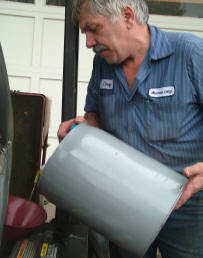


Manchester
is using its biodiesel in lawn mowers, leaf blowers, and some vehicles.
The fuel requires no alterations to the equipment, said campus mechanic
Cornelius “Corny” Troyer. An engine that runs on diesel will run on
biodiesel, too, although he is quick to note there are cold-weather
challenges and that Manchester is far from fueling all of its vehicles
with the grease concoction.


Test runs began a year ago,
when January Session students in Osborne’s Chemical Science class first
poured their experiment into an engine. Troyer is still pretty sneaky as
he oversees the biodiesel fueling of MC equipment. He doesn’t tell
machine operators they are running biodiesel so they won’t form
preconceived notions about the fuel or how it affects their engines.
He’ll arrive at work at 5 a.m., just so no one sees which fuel he is
pouring into the tanks.


So far – nary a complaint,
although mower Carl Strike is quite certain he’s whiffing French fries
as he crisscrosses the campus mall.


Amanda Patch ’08
,
a biology-chemistry major from Otterbein, Ind., is assisting Osborne –
and helped demonstrate the project at what students say is one of the
neatest convocations ever, with fireballs, a huge mower on stage, a
boots-clad executive, explosions and fire extinguishers at the ready.


Patch has medical school in
her future. “I’m doing this because I have to give back to Manchester
somehow and this is a great way to do that while learning about
chemistry and the various solutions to energy,” she said.


What’s in it for the College?
A constant reminder of the possibilities of biodiesel to students,
faculty and staff as they see mowing and leaf-blowing on campus. Good
training in environmental science for students participating in the
grease-to-diesel conversion. An environmentally cleaner campus and less
landfill waste.


With assistance from its
students, the College’s Biology and Chemistry departments can produce
about 100 gallons of biodiesel per month. (Each batch is 50 gallons.) To
supply the College’s need for 1,750 gallons a year would require larger
equipment and a funding/staffing shift from the laboratory to the
maintenance department.


And, of course, there’s the
math:


The college spends $2.60 to
$2.80 per gallon for diesel. (Some already is manufactured biodiesel,
Troyer notes)


The biodiesel costs 80 cents
a gallon to make in the lab during the school year, for a maximum output
of 900 gallons. That’s a potential $1,800 savings for the
College.


“Biodiesel is not the
answer,” admits Osborne, who is quick to note that MC academics are not
getting into the fuel business. “But we have to do something different
to help protect the environment.”


Labels: ,

AddThis Social Bookmark Button
$compressor->finish();