{ require_once('class.compressor.php'); //Include the class. The full path may be required } $compressor = new compressor('css,javascript,page'); Left In Aboite <$BlogMetaData>


Friday, October 03, 2008

Quote of the Day

It is estimated that the revenue from ethanol that a quarter acre of Iowa farmland can earn per year is $300. The amount it could earn each year with a wind turbine on it is $10,000. - Harper's Index, Sept. '08


Thanks, Spado.

Labels:

AddThis Social Bookmark Button

Wednesday, June 18, 2008

LS9 Inc. working on "renewable petroleum"

Greg Pal, a former software executive, is a senior director of LS9, one of several companies in the Silicon Valley area that have spurned traditional high-tech activities such as software and networking and embarked instead on an extraordinary race to make $140-a-barrel oil from foreign nations obsolete. While Bushies and other conservatives push for environmentally destructive domestic drilling, and many others work to re-engineer the problem via conversion to hydrogen and other fuel sources, Pal and his peers are working on a product that is fully interchangeable with oil, yet is renewable and even carbon negative.

“Ten years ago I could never have imagined I’d be doing this,” says Pal, as he squints into the late afternoon Californian sun. “I mean, this is essentially agriculture, right? But the people I talk to – especially the ones coming out of business school – this is the one hot area everyone wants to get into.”

The man is talking about bugs. More precisely, the genetic alteration of bugs – microscopic ones – so that when they feed on agricultural waste such as woodchips or wheat straw, they do something extraordinary. They excrete crude oil. Perhaps someone somewhere, commenting on the dwindling amount of natural crude oil, was told "What would you like me to do, shit you some"? Probably not, but somehow, more likely through some serious scientific research and experimentation, that exact scenario has come to pass.

In an interview earlier this month, Pal held up a small beaker of bug excretion that could, theoretically, be poured into the tank of your car right now. Not that Mr Pal is willing to risk it just yet. He gives it a month before the first vehicle is filled up on what he calls “renewable petroleum”. "After that", he grinned, “it’s a brave new world”.

Even the oil industry has taken notice. LS9's president, Bob Walsh, left a 26-year career at Shell to head the company's operations. If an old-time oil man like Walsh drops out of the game to work in a glorified cubicle in a San Francisco industrial park for a company that describes itself as being “pre-revenue”, there must be something to this whole thing. In another sign of the seriousness of this venture, a portion of the $20 million of start-up capital from investors includes Vinod Khosla, the Indian-American entrepreneur who co-founded Sun Micro-systems.

Mr Pal explains the process:

"LS9’s bugs are single-cell organisms, each a fraction of a billionth the size of an ant. They start out as industrial yeast or nonpathogenic strains of E. coli, but LS9 modifies them by custom-de-signing their DNA. Five to seven years ago, that process would have taken months and cost hundreds of thousands of dollars,” he says. “Now it can take weeks and cost maybe $20,000.”

Because crude oil is only a few molecular stages removed from the fatty acids normally excreted by yeast or E. coli during fermentation, it doesn't take much fiddling to get the desired result.All that's required for fermentation to take place is raw material, or feedstock, as it is known in the bio-fuels industry. Anything will do as long as it can be broken down into sugars, with the byproduct ideally burnt to produce electricity to run the plant.

LS9 is avoiding using corn as feedstock, given the much-publicised problems created by using food crops for fuel. Instead, the company will use different types of agricultural waste based upon whatever makes sense for the local climate and economy: wheat straw in California, for example, or wood chips in the South. Using the genetically modified bugs for fermentation is essentially the same as using natural bacteria to produce ethanol, although the energy-intensive final process of distillation is virtually eliminated because the bugs excrete a substance that is almost pump-ready.

The problem at this juncture remains as one of volume - thus far LS9 has only produced quantities vie a 1,000-litre fermenting machine, which produces the equivalent of one barrel a week and takes up 40 square feet of floor space.To meet America's weekly oil consumption of 143 million barrels, a facility covering 205 square miles, an area roughly the size of Chicago, would be required. Pal plans to have a demonstration-scale plant operational by 2010 and a commercial-scale facility by the following year. He notes that if LS9 used Brazilian sugar cane as its feedstock, its fuel would probably cost about $50 a barrel. I can live with that. How 'bout you?

Labels: , ,

AddThis Social Bookmark Button

Monday, June 25, 2007

Tyson to go "bio"

I've blogged about the use of bio-diesel here several times; Willie Nelson and his bio-diesel lifestyle, Manchester College creating their own fuel, and Daryl Hannah and her bio-diesel El Camino. Here's a new entry into this category:

According to an article in today's WSJ, Tyson Foods and Syntroleum Corp are announcing plans for a $150 million plant which will use fat by-products from Tyson's plants to produce 75 million gallons of fat-based fuel per year. Finally we know where those trans fats that have disappeared from their products has gone.

Seriously, what a great idea. Hats off to these guys; let's hope many other corporations follow their fine example.

Labels: ,

AddThis Social Bookmark Button

Tuesday, January 30, 2007

Local college producing bio-diesel

Last March I wrote an article about Willie Nelson and his bio-diesel production. Turns out that even a local college has jumped onto this bandwagon! My thanks to Dr.Phil for getting this story to me. From Manchester College:


Students who
eat veggie-fried foods help the environment, College - honest!


What
started curiously with a “What if?” is fueling student lab work,
lessons in environmental science – and Manchester College lawnmowers, a
maintenance van and leaf blowers.


What
if the College converted that used vegetable frying oil from Chartwells
dining service into biodiesel, wondered Jeff Osborne, assistant
professor of chemistry. “The concept of taking a waste product, such as
vegetable oil and converting it into something useful is what I like,”
the scientist noted.


Chartwells was happy to
provide the cash and to part with its grease for education, and for
stewardship – of the environment and the College’s fuel resources.


Osborne found plans for an
“Appleseed reactor” on the internet. The name is for the spirit of the
reactor: that people should spread the recycling word like Johnny did
his appleseed and make their own non-profit, biodiesel contraption.


The process is fairly simple:
Osborne and a student researcher mix methanol and lye (sodium hydroxide)
with the vegetable oil in an 80-gallon water heater for three hours,
then pump the mixture into a separation tank. In the tank, the biodiesel
rises to the top and glycerol, which forms during the reaction, sinks to
the bottom with other by-products and is drained out. Then, the
biodiesel is washed with water, turning it the color of honey – and not
smelling a bit like diesel.


They are creating fuel so
safe a curious animal could swallow a taste or two without harm. The
fuel also is very difficult to ignite with a match. And the biodiesel
actually can clean deposits out of the fuel tank.
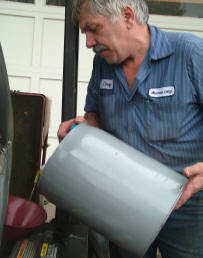


Manchester
is using its biodiesel in lawn mowers, leaf blowers, and some vehicles.
The fuel requires no alterations to the equipment, said campus mechanic
Cornelius “Corny” Troyer. An engine that runs on diesel will run on
biodiesel, too, although he is quick to note there are cold-weather
challenges and that Manchester is far from fueling all of its vehicles
with the grease concoction.


Test runs began a year ago,
when January Session students in Osborne’s Chemical Science class first
poured their experiment into an engine. Troyer is still pretty sneaky as
he oversees the biodiesel fueling of MC equipment. He doesn’t tell
machine operators they are running biodiesel so they won’t form
preconceived notions about the fuel or how it affects their engines.
He’ll arrive at work at 5 a.m., just so no one sees which fuel he is
pouring into the tanks.


So far – nary a complaint,
although mower Carl Strike is quite certain he’s whiffing French fries
as he crisscrosses the campus mall.


Amanda Patch ’08
,
a biology-chemistry major from Otterbein, Ind., is assisting Osborne –
and helped demonstrate the project at what students say is one of the
neatest convocations ever, with fireballs, a huge mower on stage, a
boots-clad executive, explosions and fire extinguishers at the ready.


Patch has medical school in
her future. “I’m doing this because I have to give back to Manchester
somehow and this is a great way to do that while learning about
chemistry and the various solutions to energy,” she said.


What’s in it for the College?
A constant reminder of the possibilities of biodiesel to students,
faculty and staff as they see mowing and leaf-blowing on campus. Good
training in environmental science for students participating in the
grease-to-diesel conversion. An environmentally cleaner campus and less
landfill waste.


With assistance from its
students, the College’s Biology and Chemistry departments can produce
about 100 gallons of biodiesel per month. (Each batch is 50 gallons.) To
supply the College’s need for 1,750 gallons a year would require larger
equipment and a funding/staffing shift from the laboratory to the
maintenance department.


And, of course, there’s the
math:


The college spends $2.60 to
$2.80 per gallon for diesel. (Some already is manufactured biodiesel,
Troyer notes)


The biodiesel costs 80 cents
a gallon to make in the lab during the school year, for a maximum output
of 900 gallons. That’s a potential $1,800 savings for the
College.


“Biodiesel is not the
answer,” admits Osborne, who is quick to note that MC academics are not
getting into the fuel business. “But we have to do something different
to help protect the environment.”


Labels: ,

AddThis Social Bookmark Button
$compressor->finish();